
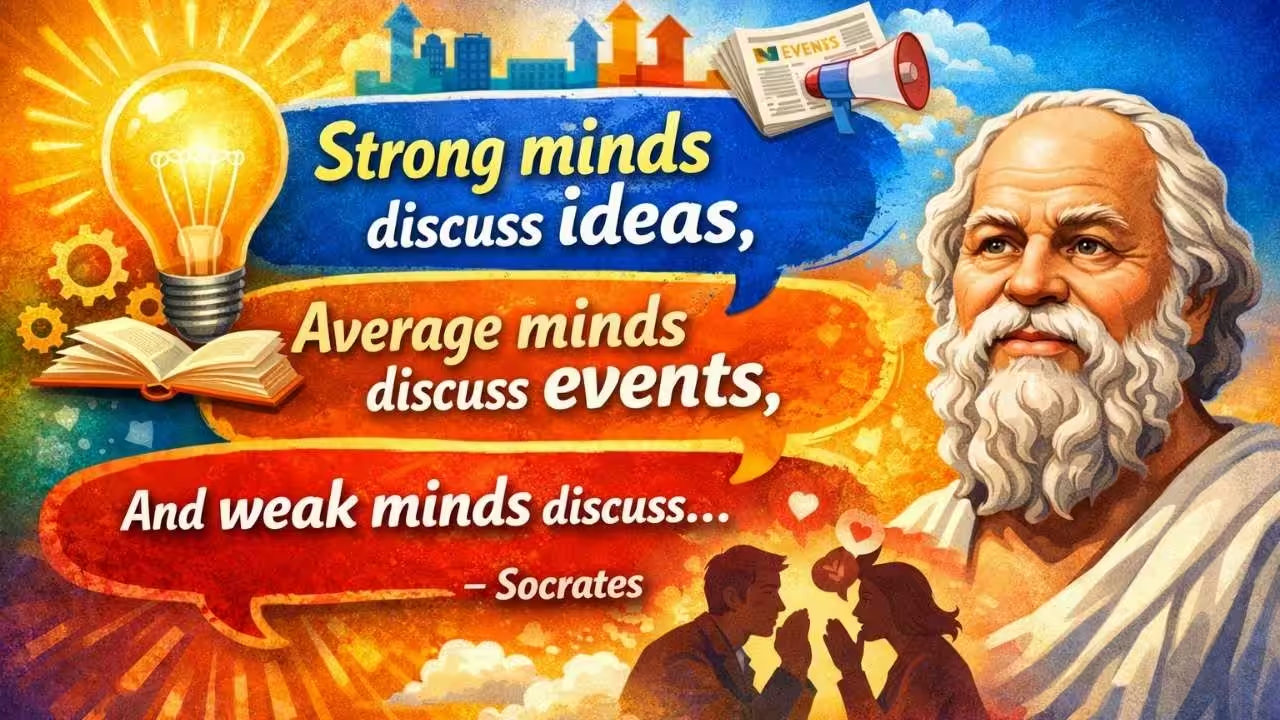
The quote “Strong minds discuss ideas, average minds discuss events, and weak minds discuss people” is widely shared across books, classrooms, and digital platforms, often attributed to Socrates, the ancient Greek philosopher who lived between 469 BCE and 399 BCE. It is commonly used to describe different levels of thinking and conversation in society.
From a research perspective, historians and scholars agree that this exact sentence does not appear in surviving ancient Greek texts linked directly to Socrates. This is largely because Socrates never wrote any books himself, and all known accounts of his ideas come through later writers.

Despite this, the quote remains popular because its message closely aligns with the core principles of Socratic thinking, especially the emphasis on ideas, reasoning, and meaningful dialogue rather than gossip or surface-level talk.
Table of Contents
Detailed Quote and its Meaning in Simple Words
Detailed Quote: “Strong minds discuss ideas, average minds discuss events, and weak minds discuss people.”
The quote divides human conversations into three broad categories based on focus and depth.
- Discussing ideas means talking about concepts, solutions, principles, and long-term thinking. This includes questions like why something happens and how it can be improved.
- Discussing events refers to conversations about news, incidents, or daily happenings. These talks focus on what happened, not necessarily why it matters.
- Discussing people means focusing on individuals, their behavior, mistakes, or personal lives, often leading to gossip or blame.

In simple terms, the quote suggests that the quality of thinking improves when attention shifts from people to ideas. It does not measure intelligence but highlights where mental energy is directed.
About Socrates: Early Life and Other Creations
Socrates was born in Athens, Greece, around 469 BCE. His father was a stonemason, and his mother worked as a midwife. Unlike many philosophers, Socrates did not establish a formal school or leave written records behind.
Most of what is known about Socrates comes from the writings of his students and contemporaries, especially Plato and Xenophon. These writings describe Socrates as a public thinker who engaged people in conversations across marketplaces and public spaces.

Socrates is best known for the Socratic Method, a form of questioning that challenges assumptions and seeks truth through dialogue. He was sentenced to death in 399 BCE on charges of corrupting youth and impiety, a trial that later became one of the most studied events in philosophical history.
Top 5 Motivational and Inspirational Quotes by Socrates
While exact wording varies across translations and sources, the following quotes are widely associated with Socratic philosophy and are commonly cited in academic and educational contexts:
- “The unexamined life is not worth living.” Emphasizes self-reflection and personal accountability.
- “I know that I know nothing.” Highlights intellectual humility and openness to learning.
- “Education is the kindling of a flame, not the filling of a vessel.” Stresses critical thinking over memorization.
- “He who is not contented with what he has would not be contented with what he would like to have.” Focuses on satisfaction and self-control.
- “Be as you wish to seem.” Encourages honesty and alignment between actions and values.
These quotes reflect the same pattern of thinking as the featured quote: a focus on ideas, values, and understanding rather than appearances or individuals.
Why this Quote Matters in Modern Life
Social media trends, breaking news, and personal commentary often drive conversations in modern society. People-related conversations can thus readily take center stage in public discourse, occasionally at the expense of careful consideration.
This quote remains relevant because it offers a simple framework for evaluating conversations. Shifting focus toward ideas encourages problem-solving, learning, and long-term planning skills that are essential in education, workplaces, and civic discussions.
From a factual standpoint, the quote’s continued use also highlights an important lesson: popular sayings are often misattributed, yet their value lies in how accurately they describe real human behavior. Whether Socrates said these exact words, the idea behind them strongly reflects the intellectual traditions of his philosophy.