
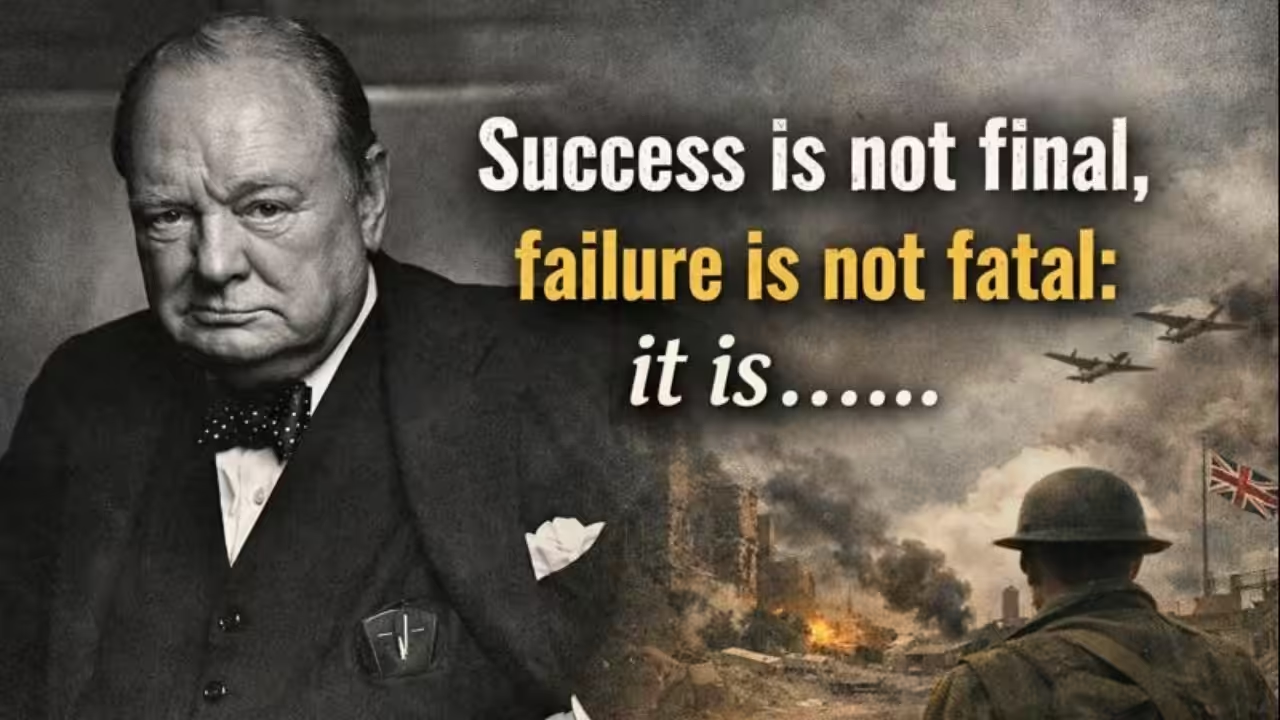
The quotation “Success is not final, failure is not fatal: it is the courage to continue that counts” is widely circulated across print, digital media, and professional training materials. It is commonly attributed to Winston Churchill and presented as a concise summary of leadership resilience and perseverance.
Archival examinations of Churchill’s authenticated speeches, books, letters, and wartime broadcasts indicate that this precise wording is absent from verified primary sources. Major Churchill research bodies therefore classify the line as misattributed, despite its strong association with him in popular culture.
Table of Contents
Quote and its Real Meaning

In practical terms, the quote emphasizes that outcomes, whether positive or negative, are temporary and should not be treated as permanent judgments. The central message focuses on continuity of effort, highlighting persistence as the defining factor in long-term achievement rather than isolated wins or losses.
This interpretation aligns with widely accepted behavioral and organizational research showing that sustained performance is more closely linked to consistency and adaptability than to single events. The quote is still important in general, even when it is not attributed to a specific historical author.
Attribution and Historical Verification
Churchill has extensively digitized and indexed his body of work, including parliamentary debates, wartime radio addresses, historical writings, and personal correspondence. Searches across these materials have not produced evidence of the full sentence as quoted today.

The phrase gained visibility primarily through late twentieth-century quote collections and motivational publications. Repeated reproduction without citations allowed the attribution to solidify over time, despite the absence of contemporaneous documentation from Churchill’s lifetime.
Relationship to Churchill’s authenticated ideas
While the wording is unverified, the theme closely reflects Churchill’s documented emphasis on endurance and morale, particularly during World War II. Churchill consistently frames setbacks in his verified speeches as challenges to overcome with determination, not as reasons for withdrawal.
Authentic Churchill quotations on persistence are supported by transcripts and dated publications, distinguishing them from later paraphrases. These verified sources provide a reliable basis for understanding his views without relying on disputed lines.
Why did the misattribution become widespread?

The quote’s style closely matches public expectations of Churchill’s rhetoric direct, motivational, and focused on resolve. This stylistic fit makes the attribution plausible at first glance, encouraging repetition without verification.
Reasons this quote spread under Churchill’s name include:
- Repeated use in books, speeches, and online platforms without links to primary sources.
- A tendency to associate brief motivational statements with historically prominent leaders.
Methods used to verify historical quotations
Historical verification depends on traceable evidence rather than popularity. Scholars prioritize original texts created during an individual’s lifetime and corroborated by independent records.
Common verification practices include:
- Systematic searches of digitized archives of speeches, books, and letters.
- Consultation with specialist historical societies and peer-reviewed research.
Author’s early life and other creations
Winston Churchill was born in 1874 and began his career as a military officer and journalist before entering politics. His early reporting on conflicts and firsthand military experience shaped his disciplined writing style and emphasis on resolve under pressure.
Beyond politics, Churchill was a prolific author who produced histories, biographies, essays, and memoirs. His extensive written output, including multi-volume historical works, forms the primary evidence base scholars use to authenticate or reject quotations attributed to him.
Practical implications for modern use
In professional and academic contexts, accurate attribution is essential for credibility. Although this quote conveys a broadly applicable message, presenting it as a verified Churchill quotation can be misleading when factual precision is required.
A data-accurate approach is to use the quote for its general meaning, noting that it reflects ideas associated with Churchill rather than his exact words. This preserves both informational integrity and the practical value of the message.