
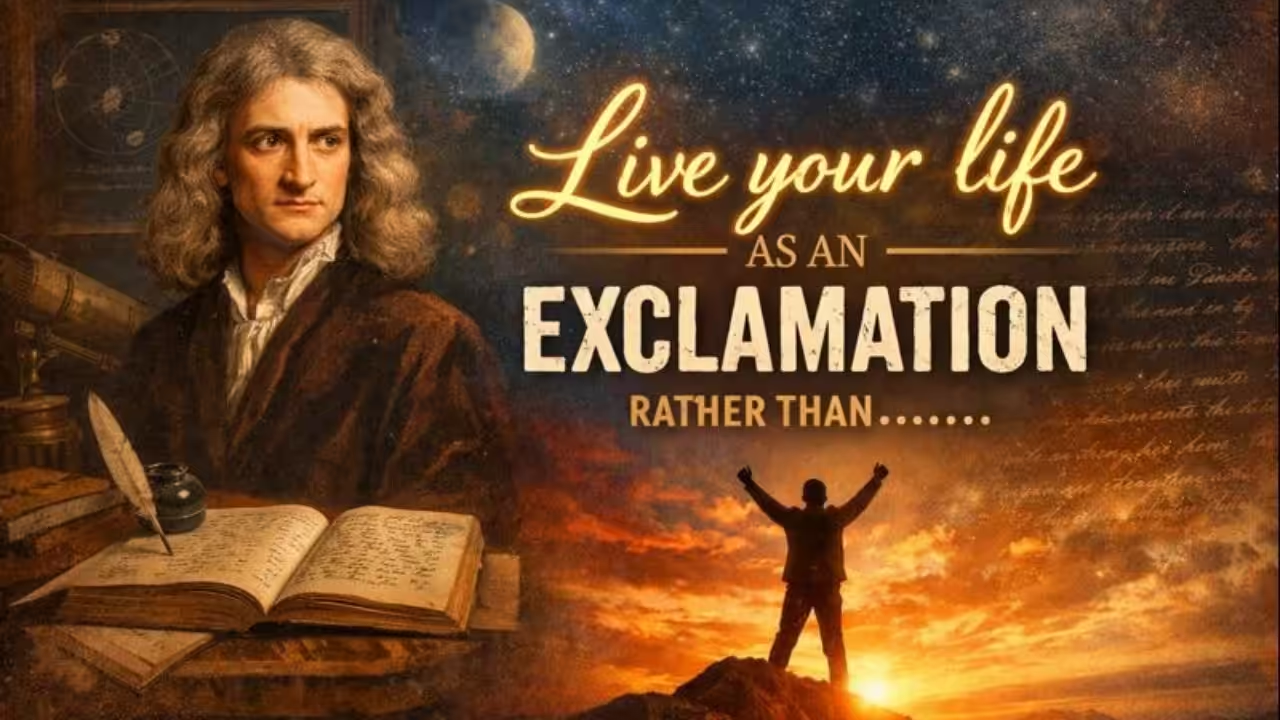
Sir Isaac Newton is one of the most influential scientists in recorded history. He made foundational contributions to classical mechanics, optics, and mathematics, and his 1687 work Principia Mathematica laid out the laws of motion and universal gravitation that shaped science for more than two centuries.
Today, inspirational quotations shared online and in print frequently link to Newton’s name. One such line, “Live your life as an exclamation rather than an explanation,” is widely circulated and attributed to him across news features, quote websites, and social media platforms.
However, reviews of Newton’s authenticated writings, letters, and major quotation archives show no confirmed primary source for this exact sentence. As a result, the quote is best described as widely attributed to Isaac Newton, with no verified historical citation, a distinction that matters in factual and academic contexts.
Table of Contents
Quote and its Meaning in Daily Life
The quote contrasts two ways of living. An “explanation” suggests constant justification, time spent defending choices, or attempts to convince others. An “exclamation” suggests action, letting results, effort, and consistency speak for themselves.
In everyday life, this idea is often interpreted in practical terms: focus on doing meaningful work, meeting responsibilities, and making progress rather than repeatedly explaining intentions. While the wording may be modern, the concept aligns with widely accepted principles of productivity and personal accountability.
It is important to note that this interpretation reflects modern usage of the quote, not a documented philosophical position written by Newton himself.
Isaac Newton’s Early Life
Isaac Newton was born on 25 December 1643 (4 January 1644, New Style) in Woolsthorpe, Lincolnshire, England. He was born prematurely and did not know his father, who died before Newton’s birth. His early education took place at local grammar schools before he entered Trinity College, Cambridge, in 1661.
During his early adulthood, particularly between 1665 and 1667, often called his “annus mirabilis,” Newton developed early ideas in calculus, optics, and gravitation while working independently during a university closure caused by the plague. These early years helped him develop the scientific methods and discipline-focused way of thinking that he is now known for.
Top 5 Quotes Attributed to Isaac Newton

Below are five of the most commonly cited quotes associated with Newton. Some are well documented, while others are popular attributions that should be used with care.
- “If I have seen further, it is by standing on the shoulders of giants.”
- “What we know is a drop; what we don’t know is an ocean.”
- “Truth is ever to be found in simplicity, and not in the multiplicity and confusion of things.”
- “I can calculate the motion of heavenly bodies, but not the madness of people.”
- “Live your life as an exclamation rather than an explanation.”
Among these, the first quote is firmly supported by Newton’s correspondence, while others, including the exclamation quote, are commonly attributed but not definitively sourced.
How this Quote Applies in Modern Life
In modern professional and social environments, the quote is often used to emphasize results-driven behavior. Employers, educators, and productivity experts frequently stress measurable outcomes over verbal justification, a theme that mirrors the “exclamation over explanation” idea.
The quote originates from the world of digital culture, where people prioritize completing visible actions, demonstrating skills, and achieving goals over elaborate explanations. This explains why the phrase continues to circulate widely despite its uncertain origin.
From a factual standpoint, the quote’s modern relevance lies not in its historical authenticity but in how its message aligns with contemporary values around accountability, efficiency, and action-based credibility.
Wise men think that the future is related to the past. Intellectual men think they can change the world we live now by modernized the way we are going through the same thing together in order to make sure we have a good relationship together with each others in order to make a difference.