
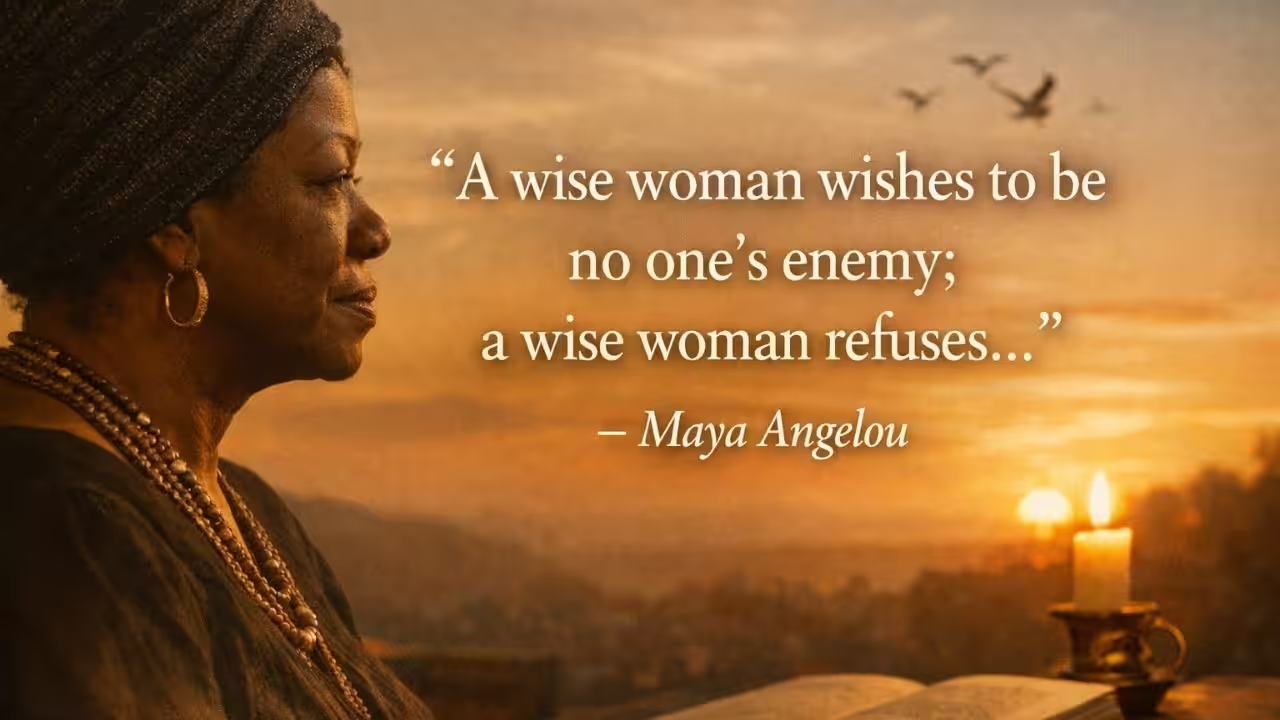
Few modern writers have shaped public conversations around dignity and personal strength as clearly as Maya Angelou. One of her most frequently repeated lines continues to appear in classrooms, workplaces, and leadership discussions because of its calm but firm moral guidance. Though brief, the sentence carries a layered message that reflects Angelou’s lived experience and lifelong philosophy.
Rather than relying on abstract moral theory, Angelou’s writing consistently offered guidance that could be applied in everyday situations. Her words spoke to how people should carry themselves when facing pressure, disagreement, or injustice, making her work both accessible and enduring.
Table of Contents
Philosophical Balance at the Heart of the Quote
Quote: “A wise woman wishes to be no one’s enemy; a wise woman refuses to be anyone’s victim.”
What gives this particular quote its staying power is the way it brings together two ideas that might otherwise seem contradictory. On one side, it encourages restraint and composure. On the other hand, it firmly rejects passivity or self-erasure.
The message does not promote avoidance or weakness. Instead, it outlines a middle path: refusing unnecessary conflict while also refusing mistreatment. This balance explains why the quote resonates in professional ethics, education, and personal development settings alike.
Literary Context and Origin

The quote is most often traced back to Letter to My Daughter, a collection of reflective essays written as guidance rather than memoir. In this work, Angelou positioned herself as a mentor figure, offering wisdom shaped by decades of personal and public life.
The essays were intentionally concise and self-contained. Each piece was designed to stand on its own, which is why individual sentences from the book are frequently quoted independently without losing their intended meaning.
Practical Interpretation in Everyday Terms
The opening idea of the quote focuses on intentional restraint. Choosing not to become an enemy suggests emotional control, patience, and the ability to step back from unnecessary confrontation. It promotes thoughtful responses rather than impulsive reactions.

The second idea shifts toward personal authority. Declining to be a victim reinforces the importance of boundaries, self-respect, and decisive action when faced with harm or injustice. Together, these ideas form a framework for strength that does not rely on aggression.
Early Life and the Roots of Her Perspective
Born in 1928 in St. Louis, Missouri, Maya Angelou experienced a childhood marked by disruption, trauma, and extended silence. Much of her early life was spent in Arkansas, where these experiences deeply shaped her understanding of resilience and identity.
These formative years influenced her sensitivity to language and her belief in the power of self-definition. Long before her public recognition, Angelou developed a worldview centered on dignity, inner strength, and the refusal to be diminished by circumstances.
A Career That Extended Beyond the Page

Angelou’s influence was not limited to literature alone. While she is best known for poetry, autobiographies, and essays, her career expanded into film, television, and public speaking, allowing her ideas to reach a global audience.
Her work behind and in front of the camera, along with her role as a speaker at major civic and cultural events, reinforced her position as a moral voice in American public life.
Maya Angelou’s Professional Contributions
| Area | Nature of Work |
|---|---|
| Literature | Poetry, essays, autobiographical volumes |
| Film | Acting, screenwriting, directing |
| Television | Commentary, narration, cultural programming |
| Public Engagement | Lectures, ceremonial readings, advocacy |
Themes Repeated Across Her Most Quoted Lines
Angelou’s most cited statements tend to share common foundations. They acknowledge hardship without glorifying it and emphasize choice without ignoring reality. This consistency is part of what makes her voice instantly recognizable.
Across her body of work, several core principles appear again and again:
- Personal dignity as a non-negotiable value
- Accountability for one’s choices and responses
- Strength grounded in self-knowledge rather than control over others
These themes connect her poetry, essays, and speeches into a coherent moral vision.
Why the Quote Remains Relevant Today
The lasting appeal of this quote lies in its clarity and balance. It encourages peace without submission and strength without hostility. In a world often divided between confrontation and compliance, Angelou’s words offer an alternative rooted in self-respect.
Its continued use across generations reflects not only the precision of her language but also the universality of her message. The quote stands as a distilled expression of Maya Angelou’s broader legacy: calm strength, moral clarity, and unwavering dignity.