
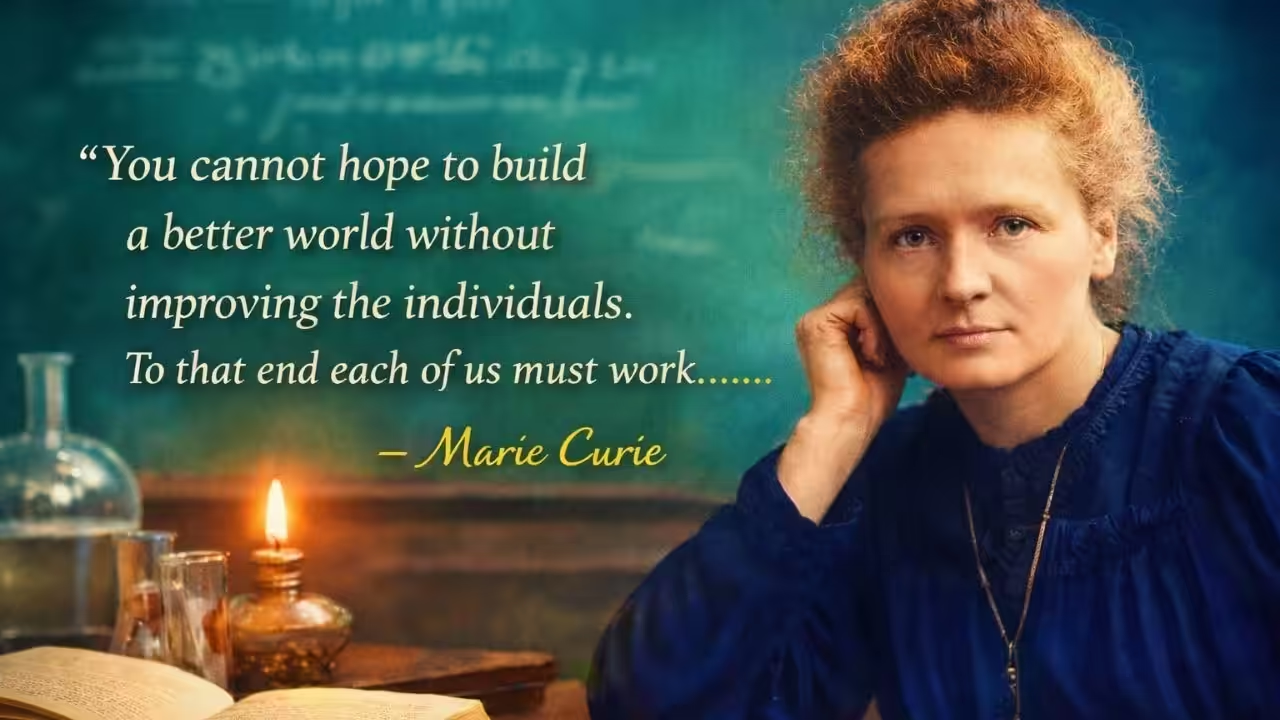
When discussions turn to fixing society’s biggest problems, the focus often shifts toward governments, systems, or sweeping reforms. Yet some of the most enduring ideas about change point in a very different direction. One such idea comes from Marie Curie, whose reflections on responsibility continue to resonate long after her lifetime.
Her thinking does not promise quick transformation or dramatic solutions. Instead, it calls for something more demanding: steady personal improvement paired with a genuine concern for others. What makes this perspective especially powerful is that it was not theoretical. It was lived, day after day, through a life shaped by discipline, sacrifice, and service to humanity.
Table of Contents
Detailed Quote and its Meaning in Simple Words

Marie Curie believed that a better world cannot be created unless individuals work to improve themselves and accept responsibility for humanity’s well-being. She emphasized that people should help where they believe they can be most useful.
In simple language, her message is practical and grounded. She was not suggesting that individuals must fix everything or help everyone. Instead, she believed meaningful progress begins when people take ownership of their own growth and then apply their strengths in ways that genuinely benefit others. In her view, personal development was never meant to be selfish. It was preparation for service.
Her quote encourages balance between ambition and empathy, between individual effort and shared responsibility. It removes the excuse of waiting for change to come from elsewhere and places responsibility directly in human hands.
A Philosophy Reflected in Her Scientific Journey
Marie Curie’s life closely mirrored the values she expressed. Entering the scientific world at a time when women were rarely welcomed, she did not seek to challenge norms through protest or recognition. She challenged them through competence, persistence, and results.
Alongside her husband, Pierre Curie, she discovered the elements polonium and radium. These findings expanded scientific understanding of atomic behavior and later influenced medical treatments, particularly in oncology. She also introduced the concept of radioactivity, helping establish an entirely new scientific field.
Her work was driven by curiosity and purpose rather than status. Even as recognition followed, her focus remained on advancing knowledge that could serve humanity.
Education, Sacrifice, and the Will to Improve

Born in 1867 in Poland as Maria Skłodowska, Marie grew up in a household that valued learning. Her father, a science teacher, encouraged her intellectual curiosity despite limited resources. However, higher education opportunities in her homeland were restricted, especially for women.
Choosing growth over comfort, she moved to Paris to study at the Sorbonne. Life there was far from easy. Financial hardship, physical exhaustion, and isolation defined her early years. Still, she remained committed to learning, believing that self-improvement required endurance and patience.
This period shaped not only her scientific foundation but also her worldview that effort, when sustained, leads to lasting impact.
Science Used in Times of Crisis
Marie Curie’s sense of responsibility extended beyond research institutions. During the First World War, she applied her scientific expertise to urgent humanitarian needs. Rather than remaining within laboratories, she helped develop mobile X-ray units that could be transported to military hospitals.
These units allowed doctors to diagnose injuries more accurately and save lives. Her daughter, Irène, worked alongside her, reflecting how Curie’s values of service and responsibility influenced her family.
This chapter of her life demonstrated that knowledge gains its highest value when used in moments of real human need.
A Legacy That Went Beyond Awards
Despite international acclaim, Marie Curie remained focused on expanding scientific opportunity rather than personal prestige. She supported the creation of a radioactivity research laboratory in Warsaw, strengthening scientific research in her country of origin.
Over her lifetime, she received two Nobel Prizes, one in Physics and one in chemistry, an achievement that remains exceptional. Yet her influence reached far beyond awards, shaping global discussions around ethics, education, and the social responsibility of scientists.
Her life can be understood through three core commitments:
- Continuous self-improvement through learning and discipline
- Responsible use of knowledge for the benefit of humanity
- Practical service in areas where her skills could make the greatest difference
Why This Quote Still Matters
Marie Curie’s words remain relevant because the fundamental challenges facing society have not disappeared. Inequality, conflict, and misuse of knowledge persist, often intensified by modern complexity.
Her quote reminds readers that lasting progress does not begin with grand promises or external systems alone. It begins when individuals choose to grow, take responsibility, and contribute where they can truly help. Personal improvement and social responsibility are not separate ideals; they are interconnected.
In a world searching for fast solutions, her message offers a steady truth: meaningful change is built by individuals who understand that improving themselves is one of the most powerful ways to improve the world.