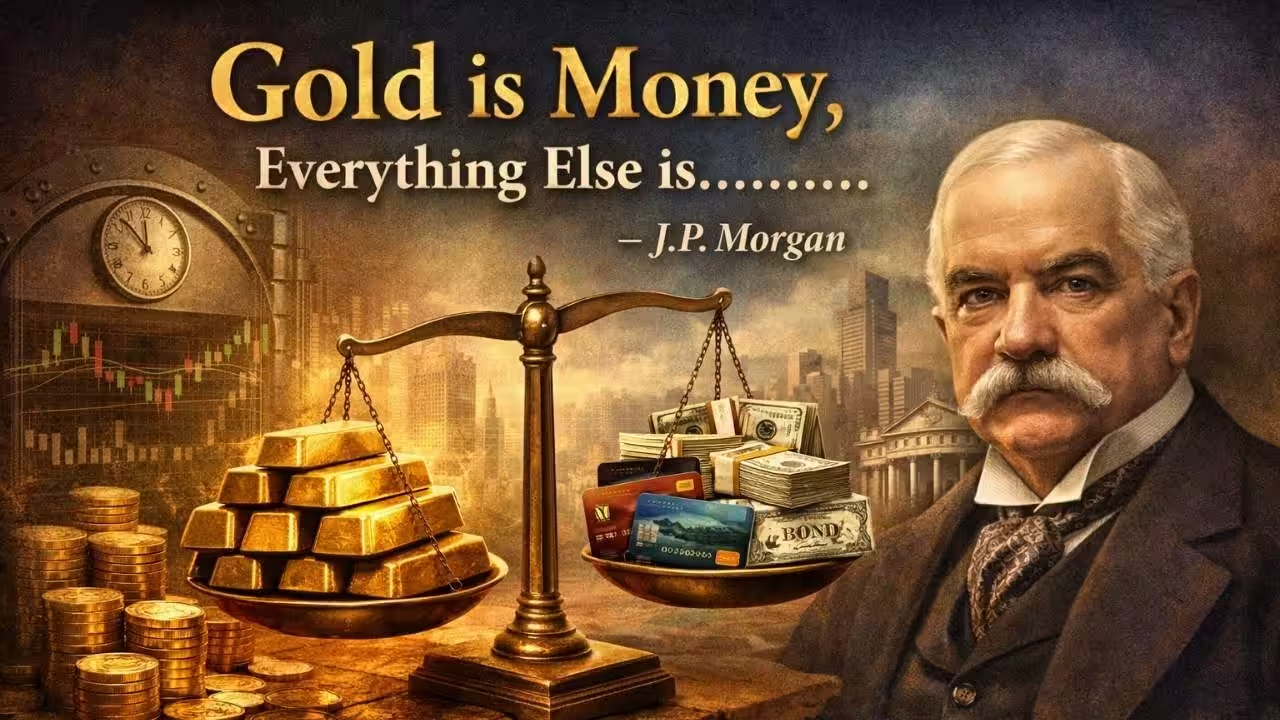
Gold has held a special place in global finance for centuries because it is scarce, durable, widely recognized, and not backed by any single institution’s promise. By the end of 2024, the estimated above-ground stock of gold was about 216,265 tonnes, and the annual mined supply was about 3,645 tonnes, a reminder that new supply grows more slowly than that of most financial assets.
Modern financial systems, however, run mostly on credit: bank deposits, loans, bonds, and digital balances that represent claims on money rather than money itself. In 2024, total gold supply (including recycling) was about 4,974 tonnes, while overall gold demand was valued at about US$382 billion, showing how gold still attracts capital even in a largely digital and credit-driven world.
This is the background behind the famous J.P. Morgan line: “Gold is money. Everything else is credit.” It is often linked to his early-20th-century remarks, when banking stability, central bank influence, and public trust were major national debates.
Table of Contents
Detailed Quote and its Meaning in Simple Words
The quote: “Gold is money. Everything else is credit.”
Meaning in simple words:
- Gold is “final payment.” If a transaction is settled in gold, no further promise is needed. The value is in the metal itself, not in a payer’s future ability to pay.
- Most other forms of “money” are actually promises. Paper currency, bank balances, bonds, and many digital instruments work because people trust the issuer, typically a government, a central bank, or a financial institution.
- Credit relies on confidence. When trust is strong, credit functions smoothly. When trust breaks during bank runs, liquidity crunches, or political shocks, credit can tighten rapidly.
- Gold sits outside the credit chain. Gold does not require a borrower, a lender, a clearing bank, or a repayment schedule. Its price can move up or down, but it is not someone else’s liability.

Practically speaking, Morgan’s statement clearly distinguishes between gold, an asset independent of promises, and most financial claims, which rely on promises being honored.
J.P. Morgan’s Early Life and Other Creations
John Pierpont Morgan, widely known as J.P. Morgan, was born on April 17, 1837, in Hartford, Connecticut. He came from a family deeply connected to finance and international business. His education included schooling in the United States and Europe, giving him an early understanding of global banking networks and the discipline of cross-border commerce.
Morgan’s early career was shaped by exposure to merchant banking and international capital flows. Over time, he built relationships with major industrial and financial leaders, gaining a reputation for structuring large deals and stabilizing distressed businesses. He became a central figure in an era when railroads, steel, and electricity were transforming economies at scale.
Morgan is most closely associated with the rise of modern American finance through large-scale organization and consolidation. Key impacts often credited to his leadership include:
- Railroad reorganizations: He played a major role in restructuring and financing large railroad systems, aiming to reduce destructive competition and stabilize cash flows.
- Formation of major industrial giants: He was connected to the financial organization behind landmark consolidations, including U.S. Steel (1901), one of the most significant corporate combinations of its time.
- Support for foundational corporate structures: He was involved in financing and organizing companies that became enduring pillars of the U.S. economy, including General Electric (1892) and International Harvester (1902).
- Financial stabilization during crises: Morgan’s influence was especially visible in periods of market stress, when private banking syndicates and prominent financiers could play a decisive role in restoring confidence.
Morgan died on March 31, 1913, in Rome, Italy, leaving behind a legacy that still shapes how people discuss banking power, market stability, and the relationship between money and trust.
Top 5 Inspirational Quotes by J.P. Morgan
Below are five quotes commonly attributed to J.P. Morgan and frequently cited in business and finance writing:
- “Gold is money. Everything else is credit.”
A reminder that many “assets” are ultimately trust-based promises. - “A man always has two reasons for doing anything: a good reason and the real reason.”
A practical lens for decision-making, especially useful in negotiations and business strategy. - “In business, a reputation for honesty is worth more than money.”
A direct statement about trust as an economic asset that compounds over time. - “I owe the public nothing.”
The statement is often discussed as a window into the mindset of elite finance in that era, whether admired for its bluntness or criticized for its detachment, and it highlights the tension between private power and public expectations. - “The first thing is character.”
A short line frequently tied to Morgan’s preference for dealing with people he considered reliable, especially in high-stakes finance.
How This Quote Applies in Daily Modern Life
Most people are paid by bank deposit, not in cash. A bank deposit is a claim on money, supported by the bank’s ability to meet withdrawals and the broader financial safety net. Day-to-day life works because systems are stable, but the quote encourages a healthy awareness: what looks like “money” may function as credit.
Modern consumption often runs on revolving credit. Morgan’s framing helps clarify what is happening: purchases are not always settled immediately with “final money”; they are frequently settled with promises spread over time. This can be useful when managed well, but risky when obligations exceed income resilience.
The quote is not telling everyone to store gold. It highlights that during stressful moments, job loss, medical emergencies, sudden inflation, banking disruptions, liquidity, and certainty matter. In personal finance, this translates into practical steps such as maintaining emergency funds, controlling high-interest debt, and avoiding over-leverage.
Even official currency can lose purchasing power over time. Gold’s appeal historically rises when people worry about inflation, currency debasement, or geopolitical instability. In daily life, the lesson is broader: focus on real-value skills, diversified savings, and assets with durable demand, rather than assuming that nominal numbers always preserve purchasing power.
Most of modern life depends on trust: employers pay on time, banks clear transactions, governments enforce contracts, and markets stay liquid. Morgan’s quote is essentially a reminder that trust is a system resource. When trust is high, credit expands, and life feels smooth. When trust weakens, credit tightens, and people suddenly care a lot more about certainty.
Morgan’s line is best read as a warning about overconfidence in promises, not as a command to reject modern finance. In practical, modern terms, it supports a disciplined approach: keep debt manageable, maintain liquidity, diversify risk, and determine whether what you own is an asset or a claim.