
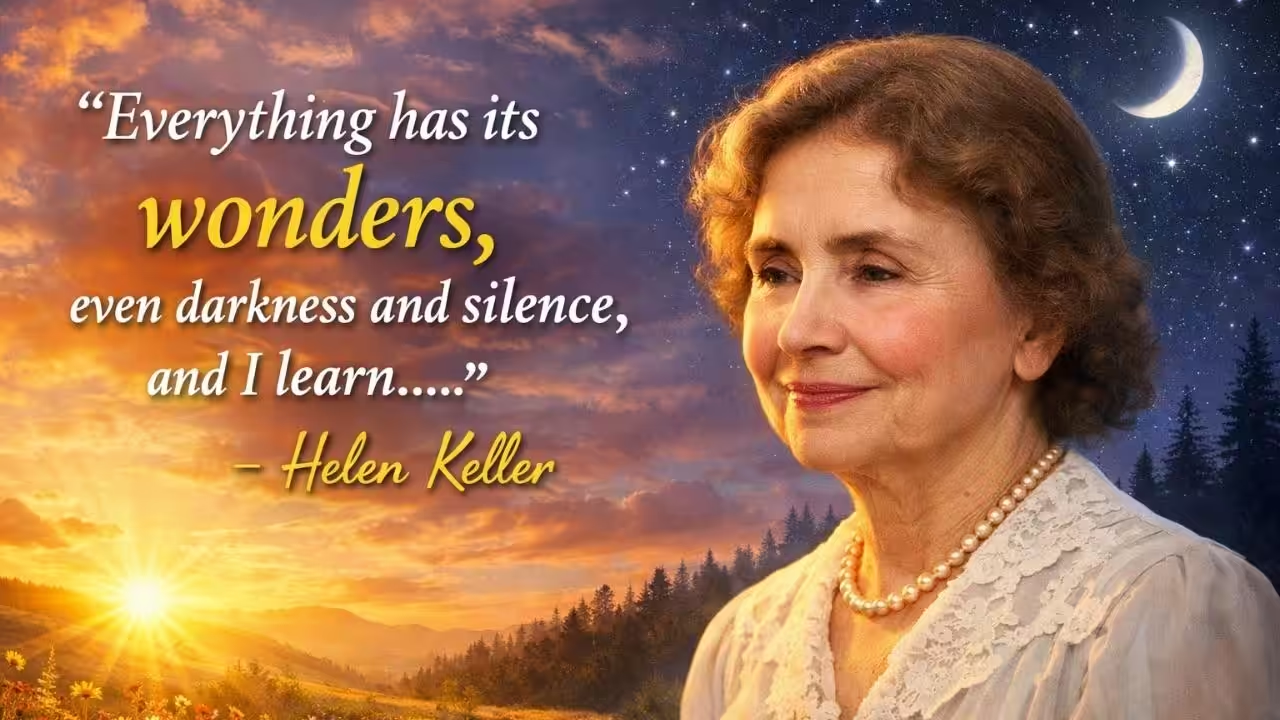
Helen Keller (1880–1968) was an American author, lecturer, and disability rights advocate who became deaf and blind after a severe illness at about 19 months old. Despite losing both sight and hearing in early childhood, she learned to communicate through touch and later became the first deafblind person known to earn a Bachelor of Arts degree (from Radcliffe College in 1904).
Keller wrote multiple books and hundreds of speeches and essays across her lifetime. One of her best-known works is her autobiography, The Story of My Life, first published in 1903, which describes her education, relationships, and experiences of the world through touch, vibration, smell, and taste.

The quote, “Everything has its wonders, even darkness and silence, and I learn, whatever state I may be in, therein to be content,” appears in The Story of My Life (in “Part 6” in several published and archival versions). In context, she is explaining that even with real limits, her life still “touches” the beauty of the world, and she trains herself to live with calm acceptance.
Table of Contents
The Quote (Exact Text) – Clear Meaning in Basic English
“Everything has its wonders, even darkness and silence, and I learn, whatever state I may be in, therein to be content.”
Author: Helen Keller
Common placement: The Story of My Life (autobiography)
This quote can be understood in plain terms:
- Nothing is completely empty of value. Even difficult or quiet periods can contain something useful or meaningful.
- Acceptance can be trained. Keller presents contentment as something a person develops by changing habits of attention, gratitude, and thinking.
- A person’s condition does not decide their inner life. “Whatever state I may be in” refers to circumstances, health, limitations, mood, or hardship; she is saying that peace is still possible within those boundaries.
Where the Quote Comes From and Why Context Matters
This line is not a stand-alone slogan. Keller wrote it while reflecting on the contrast between what she could not access (light and sound) and what she could access deeply (people, nature, literature, conversation through touch, and meaningful friendships). In that chapter/section, she describes daily life, travel, theatre experiences, and her encounters with well-known cultural figures of her era, then concludes by stating that her life still connects with the “World Beautiful.”
That context is important because it shows two key points:
- She is not denying hardship. “Darkness and silence” are real limitations in her life, not a metaphor she borrowed casually.
- She is describing a learned skill. She says, “I learn… to be content,” meaning contentment is a practice built over time, not something that arrives automatically.
Phrase-by-Phrase Breakdown
| Phrase from the quote | Simple meaning | What it suggests in real life |
|---|---|---|
| “Everything has its wonders” | Many situations contain something worth noticing | Look for value, learning, or beauty even in normal days |
| “even darkness and silence” | Even the hardest limits can hold meaning | Do not assume difficulty equals “nothing good” |
| “I learn” | This takes time and effort | Build habits; do not expect instant change |
| “whatever state I may be in” | Any situation, good or bad, can happen | Prepare for ups and downs without losing stability |
| “therein to be content” | Be at peace within that situation | Practice calm acceptance while still improving life |
Fact-Based Snapshot of Helen Keller
| Topic | Factual detail (high-level) | Why it connects to the quote |
|---|---|---|
| Birth–death | 1880–1968 | She lived through major social and political changes and wrote across decades |
| Disability onset | Lost sight and hearing after illness around 19 months old | “Darkness and silence” describes her lived reality |
| Key teacher | Anne Sullivan began teaching her in 1887 | Keller’s progress was built through structured learning and support |
| Education milestone | BA from Radcliffe College in 1904 | Shows long-term effort and learning methods that worked |
| Major work | The Story of My Life (published 1903) | The quote comes from this autobiographical writing |
| Public work | Lectures, writing, advocacy | Her message was meant to educate the public, not only inspire |
What Makes This Quote “Informative,” Not Just Inspirational

Many quotes sound positive, but this one is especially practical because it describes a method:
- Notice something meaningful in the present moment.
- Accept the situation without giving up self-respect.
- Keep learning inside the limits you have today.
Keller’s life adds a factual base to the message. She did not write as a distant observer; she wrote as someone working daily with barriers to communication, access to education, and public attitudes toward disability.
Common Misunderstandings and Accurate Clarifications
- Misunderstanding: “Content” means doing nothing and staying passive.
Clarification: Keller’s life shows active effort education, public speaking, writing, and organizing. Contentment here means inner stability, not inactivity. - Misunderstanding: The quote says hardship is “good.”
Clarification: It does not praise hardship. It says even hardship can contain something worth learning from or noticing. - Misunderstanding: “Darkness and silence” is only a metaphor for sadness.
Clarification: For Keller, those words describe her sensory reality. The metaphor is secondary.
Practical Ways to Apply the Quote Without Over-Simplifying it
- Name the situation clearly: What exactly is happening right now (health issue, job stress, financial pressure, grief, uncertainty)?
- Separate facts from guesses: What is confirmed, and what is fear or prediction?
- Find one “wonder” that is real: A supportive person, a small improvement, a useful lesson, a skill you can build, or a quiet break your body needed.
- Choose one controllable step: One call, one form, one appointment, one page read, one walk, one budget check, small but real.
- Track progress weekly: Contentment grows when people see stability improving over time, even slowly.
This approach keeps the quote grounded: it turns “wonders” into observable details and “learn” into actions repeated.
Real-World Examples of “Wonders” in Difficult Moments

Keller’s line does not require grand results. In ordinary life, “wonders” can be small but meaningful:
- During stress: learning a new routine that reduces anxiety, even if the problem remains.
- During silence/alone time: deeper focus, better rest, or reflection that supports future decisions.
- During setbacks: finding which methods do not work so effort becomes more efficient next time.
- During slow progress: noticing resilience and patience growing (skills that often matter later).
These examples keep the quote factual and practical: they are results people can measure (sleep, routine consistency, learning outcomes, reduced mistakes).
Why This Quote Still Gets Shared Today
This quote remains popular because it fits modern problems that many people face:
- Information overload: The idea of being “content” can mean reducing noise and choosing calm focus.
- Uncertainty and change: “Whatever state I may be in” matches unstable work, health, and social conditions.
- Mental load: The phrase “I learn” supports the idea that coping skills are trainable, not fixed personality traits.
It is also widely quoted because it is short, memorable, and tied to a well-documented life story that people recognize.
Quick “Do’s and Don’ts” When Using This Quote
- Do use it as a reminder to practice acceptance while taking realistic steps.
- Do keep the original wording when quoting it publicly.
- Don’t use it to dismiss someone’s pain (“be content” should not mean “stop complaining”).
- Don’t treat disability as a “lesson for others” without respect; Keller’s life is not a motivational prop. She was a writer, student, and advocate with her aims.
Why This Quote Still Matters
Helen Keller’s words remain powerful because they are rooted in lived experience, not theory. Her quote does not promise comfort without effort, nor does it deny hardship. Instead, it presents contentment as a skill shaped by patience, learning, and honest acceptance.
In a world where many challenges cannot be fixed immediately, this quote reminds readers that peace does not require perfect conditions. It requires clarity, discipline, and the willingness to adapt. That lesson, grounded in fact and experience, is why this quote continues to educate and guide readers across generations.