

Helen Keller is recognized globally as one of the most influential figures in the history of disability education and advocacy. Born in 1880 in Alabama, she lost her sight and hearing at 19 months of age due to illness. Through structured teaching methods and formal education, she became the first deafblind person to earn a Bachelor of Arts degree in 1904, an achievement widely documented in academic and historical archives.
Among her most referenced statements is the quote, “When one door of happiness closes, another opens, but often we look so long at the closed door that we do not see the one that has been opened for us.” The line gained public recognition through her writings in the late 1920s and continues to be used in education, counseling, and leadership training as a reflection on human behavior and attention.
Table of Contents
Quote in Detail and its Meaning

The quote is most often associated with Keller’s 1929 book We Bereaved and was later repeated in The Open Door published in 1957. Historical research shows that similar expressions appeared in earlier printed sources, but Keller’s version became widely accepted due to her international reputation and readership.
The meaning of the quote centers on a documented pattern of human response to loss. When a source of happiness ends, such as employment, health, or a personal relationship, attention naturally turns to what has disappeared. At the same time, new possibilities may exist but remain unseen because emotional and mental focus remains fixed on the loss.
Rather than presenting optimism alone, the quote highlights a factual point about perception and awareness. It explains that opportunities are not always absent after failure or change; they are often overlooked because of a prolonged focus on disappointment. This interpretation is consistent with subsequent discoveries in behavioral science regarding attention and decision-making.
Helen Keller’s Early Life and Creations
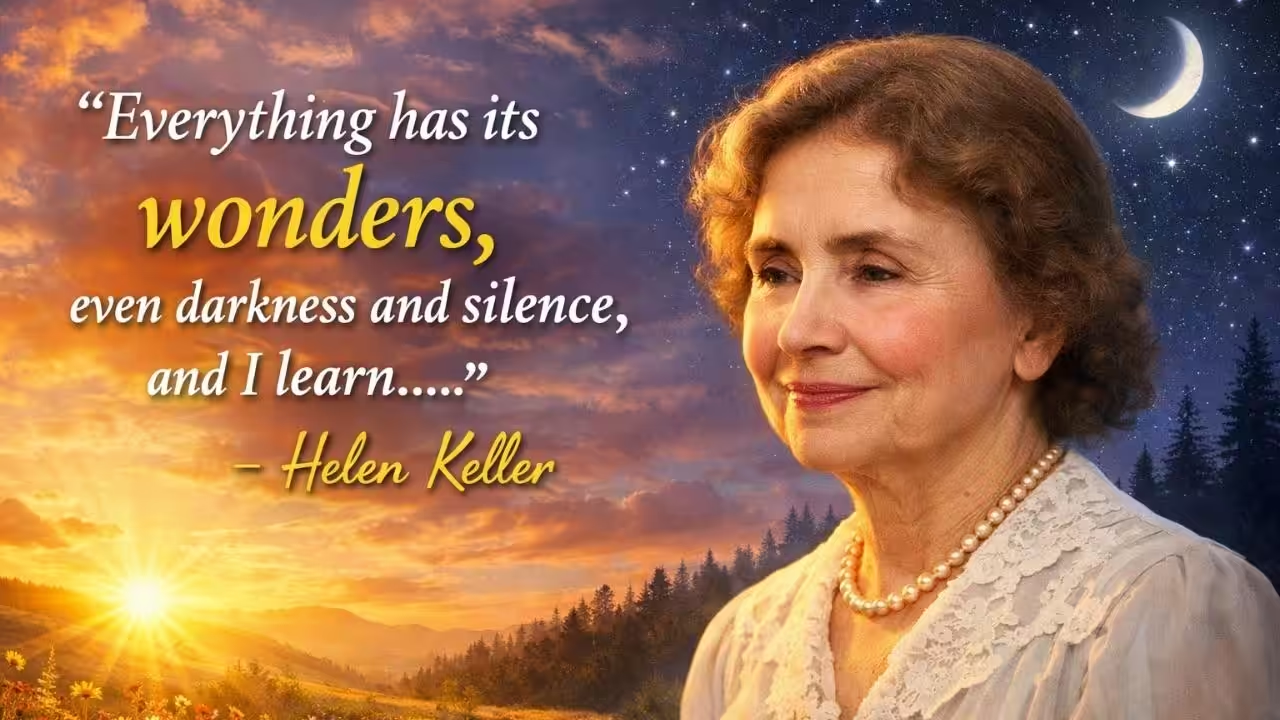
Keller’s formal education began in 1887 when teacher Anne Sullivan introduced tactile learning techniques using object association and hand spelling. This method allowed Keller to develop language skills and gradually move into reading and writing.
One of her earliest known creative works was a short story titled The Frost King, written in 1891. The story became historically important after questions of originality arose, leading to a documented inquiry into her learning methods. This event shaped her future training by placing greater emphasis on guided reading and structured writing practices.
As she matured, Keller produced more advanced literary works. Her autobiography, The Story of My Life, published in 1903, became an international reference text for understanding education among people with sensory disabilities. These early creations laid the foundation for her later role as a writer and public speaker.
Global Recognition and Literary Contribution

Over her lifetime, Keller wrote more than a dozen books and hundreds of essays and speeches. Her works addressed education, social equality, and the rights of people with disabilities. She traveled extensively across the United States and other countries, delivering lectures that reached large audiences during the early 20th century.
She also worked with major organizations focused on blindness and rehabilitation, contributing to policy discussions and public awareness campaigns. Her influence extended beyond literature into public service and international advocacy, making her one of the most documented voices in disability history.
By the time of her death in 1968, Keller had received numerous honors, including national and international awards recognizing her contributions to education and human rights. Her published works remain part of academic curricula and institutional archives.
Top 5 Quotes of Helen Keller
The following quotations are among the most frequently cited lines from Keller’s writings and speeches:
- “When one door of happiness closes, another opens, but often we look so long at the closed door that we do not see the one that has been opened for us.”
- “The best and most beautiful things in the world cannot be seen or even touched, but must be felt with the heart.”
- “Life is either a daring adventure or nothing.”
- “Keep your face to the sunshine, and you cannot see the shadows.”
- “The chief handicap of the blind is not blindness, but the attitude of seeing people toward them.”
These quotations appear in different periods of her work and consistently reflect themes of perception, adjustment, and human dignity.
How This Quote Applies in Modern Life
Modern data shows that large populations experience major life changes each year, including job displacement, academic failure, and health-related disruptions. Studies on work and education say that millions of people change jobs every year in both developed and developing countries. In these situations, emotional attention often remains fixed on what has ended rather than on available alternatives.
The quote aligns with research in psychology and decision science that demonstrates how focus affects problem-solving ability. Individuals who concentrate only on setbacks show reduced engagement with retraining programs, career counseling, and support networks. In contrast, those who redirect attention toward available options are statistically more likely to pursue new qualifications or employment paths.
In the digital age, the quote has become more relevant due to constant exposure to negative comparisons on social media and in online news. Continuous reflection on losses can limit awareness of realistic opportunities within one’s environment. Keller’s statement functions as a factual observation of human attention rather than emotional reassurance, emphasizing that outcomes improve when perception shifts from closed possibilities to open ones.
I have been able to adjust to changes when a door closes by looking at other possibilities. When I lost my job as an educator I looked out the window and saw children walking to school. The idea came to me to open a daycare center and work for myself. I was successful eventually earning more money than at my previous job.