
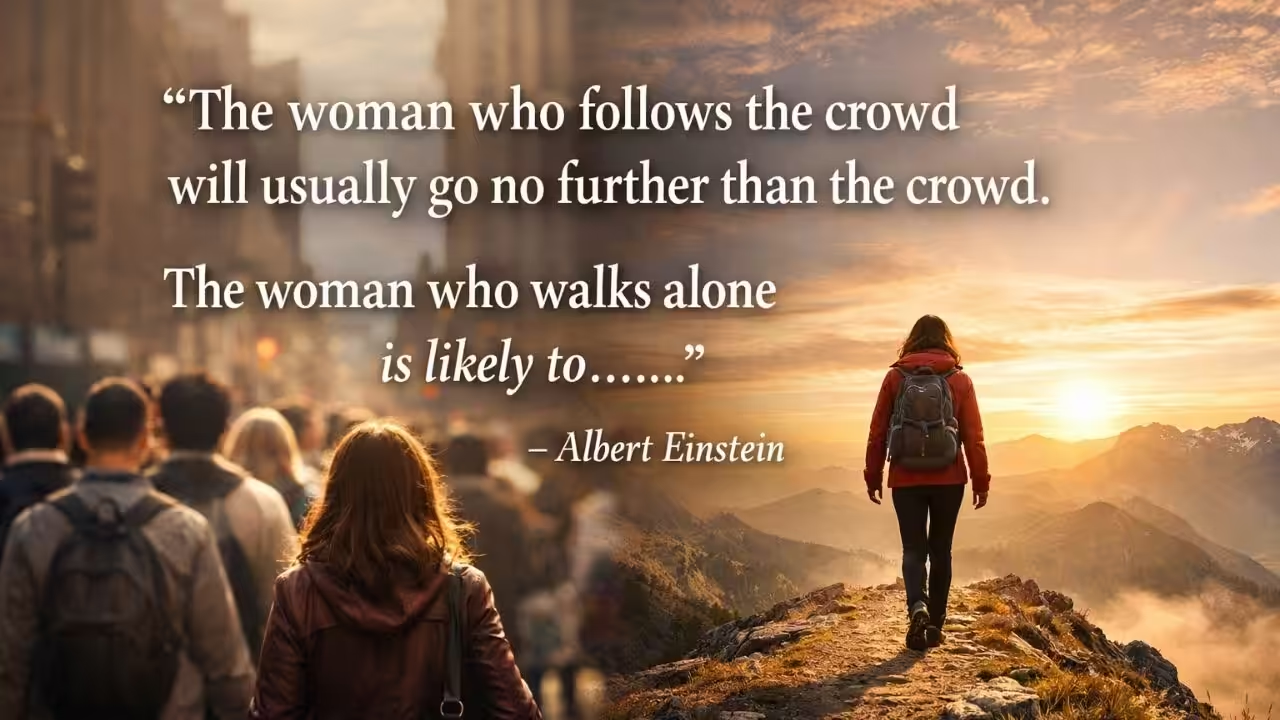
Albert Einstein (1879–1955) is among the most quoted individuals in global history, with his name frequently attached to statements about creativity, originality, and independent thinking. Over time, his name has been widely associated with numerous quotations, despite the scarcity or absence of direct documentary evidence.
One such quote, “The woman who follows the crowd will usually go no further than the crowd. The quote, “The woman who walks alone is likely to find herself in places no one has ever been before,” continues to appear in newspapers, educational content, and daily quote features. Its repeated use has strengthened public belief in its authenticity, even as research raises questions about its true origin.
Table of Contents
The Quote as Commonly Shared
“The woman who follows the crowd will usually go no further than the crowd.
The woman who walks alone is likely to find herself in places no one has ever been before.”
This version, which uses the word “woman,” is the most widely circulated today and is often presented as a statement by Albert Einstein.
Detailed Meaning of the Quote
At its core, the quote contrasts two distinct approaches to decision-making. The first part focuses on following collective behavior. When individuals rely mainly on existing trends, shared opinions, or established paths, the outcome is usually predictable and limited to what others have already achieved.
The second part emphasizes independent action. “Walking alone” does not imply isolation in a social sense, but rather making decisions without depending entirely on popular opinion. The language suggests that original outcomes are more likely when choices are made independently, even when they involve uncertainty or risk.
From a structural standpoint, the quote uses simple cause-and-effect logic. Conformity leads to familiar destinations, while independent paths increase the possibility of reaching new or uncommon outcomes.
How the Quote Applies in Modern Life
Trends, algorithms, and collective behavior heavily influence decision-making in modern society, particularly through digital platforms. What is most visible or widely accepted often shapes education choices, career paths, investments, and even personal opinions.
The quote’s message corresponds with discernible trends in innovation and leadership. Many advancements in technology, science, business, and social reform have come from individuals or small groups who initially acted outside mainstream expectations. Independent choices do not always lead to success, but historical data show that major change usually requires more than just consensus.
In practical terms, the quote reflects a broader social reality: systems tend to reward conformity with stability, while originality carries higher uncertainty but also higher potential for unique outcomes.
Authorship and Attribution Status
Despite its frequent association with Einstein, the quote does not appear in verified collections of his writings, speeches, or correspondence. Scholars and quotation researchers have noted that the earliest documented instances of similar wording appeared after Einstein’s death, in 1955.
Earlier versions of the quote used terms such as “man,” “person,” or “one,” indicating that the wording evolved. The modern use of “woman” appears to be a later adaptation, reflecting changing language preferences rather than the author’s original intent.
Historical Development and Wording Changes
The quote’s journey from an obscure motivational text to a widely attributed saying was gradual. Posters, books, and informal publications featured the quote before digital quote collections repeatedly credited it to Einstein.
Evolution of the Quote Over Time
| Period | Common Wording Used | Observed Trend |
|---|---|---|
| 1970s | “The man who follows the crowd…” | Early print and poster usage |
| 1980s | “The person who follows the crowd…” | Neutral language in talks |
| 1990s | Mixed wording | No consistent attribution |
| 2000s–present | “The woman who follows the crowd…” | Modernized phrasing |
Why the Quote Became Linked to Einstein
The association with Einstein is not unusual. Well-known historical figures are often credited with general wisdom statements, particularly when the quote reflects traits commonly associated with them, such as originality or independent thinking.
Factors Behind the Misattribution
- Einstein’s reputation as a symbol of intellectual independence plays a significant role.
- The attribution is often repeated on quote websites without requiring source verification.
- Increased credibility when motivational quotes are linked to famous names.
These factors have contributed to long-term public acceptance of the attribution despite limited evidence.
Comparison With Verified Einstein Quotations
Authentic Einstein quotations usually come from traceable sources, such as published letters, lectures, or interviews. They often discuss scientific responsibility, imagination, learning, and ethical considerations related to knowledge.
Verified Einstein Quotes vs. the Disputed Quote
| Aspect | Verified Einstein Quotes | Disputed Crowd Quote |
|---|---|---|
| Source type | Letters, lectures, interviews | Posters and later print |
| Subject focus | Science, education, ethics | Motivation and individuality |
| Documentation | Archival records | No original manuscript |
| Language style | Analytical and reflective | Inspirational and generalized |
A Quote That Continues to Inspire
Regardless of its disputed authorship, the quote continues to resonate because it reflects a broadly observable truth about human behavior. Its continued use in leadership training, education, and personal development highlights its relevance rather than its origin.
The quote’s endurance demonstrates that ideas emphasizing independence and originality remain appealing across generations. While factual accuracy matters in attribution, the message itself retains influence because of its clarity and applicability.
Why the Quote Remains Popular
- Simple language that is easy to remember and repeat.
- Relevance to personal and professional decision-making.
- Alignment with widely valued traits such as originality and courage.
The quote about following the crowd versus walking alone is widely shared and often attributed to Albert Einstein, but the available evidence suggests it is not a statement he made. Its wording evolved over decades, and its association with Einstein likely developed through repetition rather than documentation.
For accurate and responsible use, the quote is best described as “commonly attributed to Albert Einstein.” In this context, it can continue to serve as an illustrative statement about independence and originality while maintaining factual integrity in published content.